Data Science
Why Python is Essential for Data Science
July 13, 2026 · Super Admin · 326 views
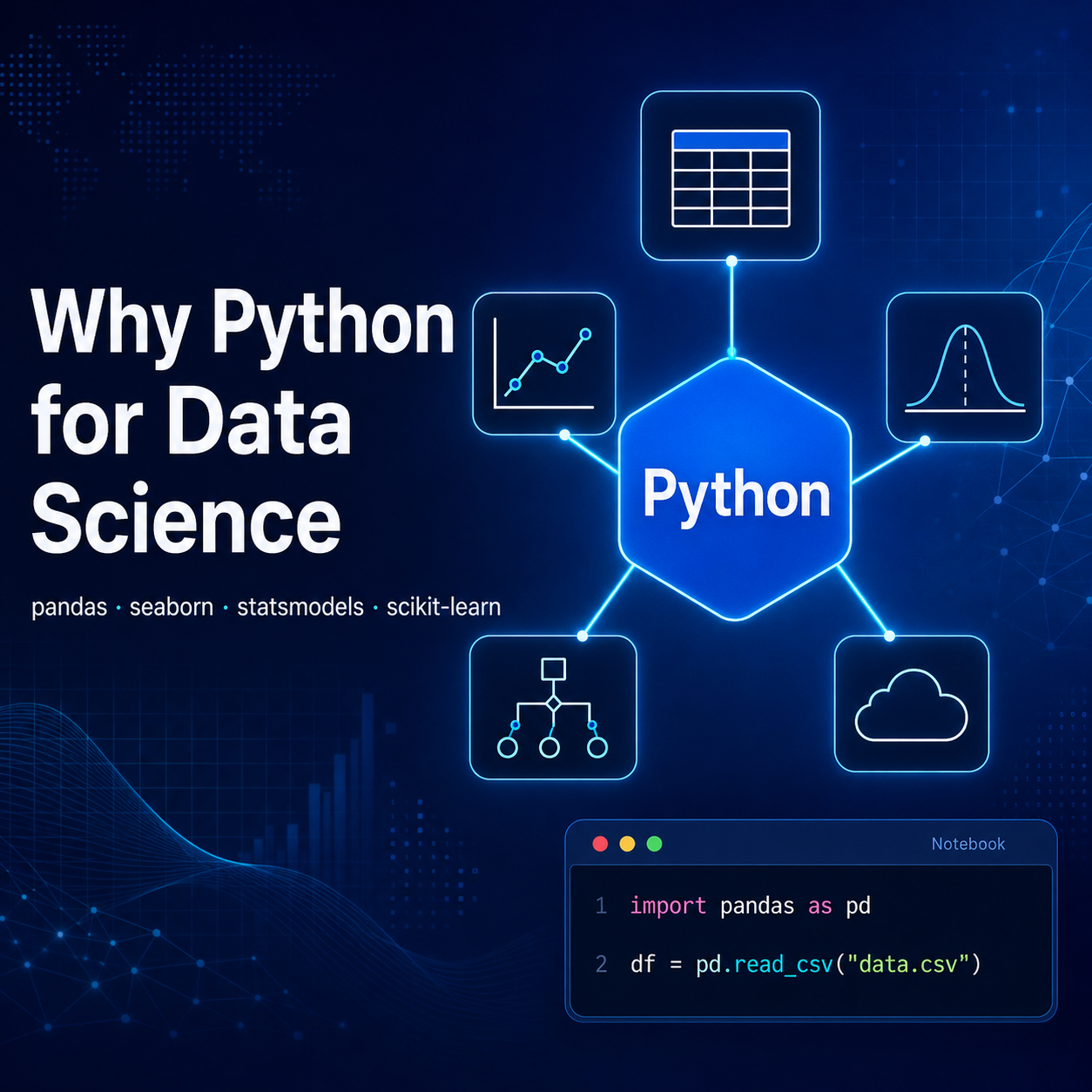
Ask why Python dominates data science and the honest answer is not elegance but coverage. A single language takes you from a messy CSV file through statistical testing, charts, machine learning and a deployed model, without switching tools or rewriting anything. For researchers who also work in SPSS or R, Python is the layer that scales when a dataset stops fitting comfortably in a spreadsheet.
The libraries are the real reason to learn it. NumPy provides fast numerical arrays; pandas gives you the DataFrame, which behaves like a spreadsheet you can command; Matplotlib and Seaborn produce publication-quality figures; SciPy and statsmodels cover the classical statistics, including t-tests, ANOVA and regression with proper summary output; and scikit-learn offers a consistent interface for classification, regression and clustering. Learning these five well is worth more than a passing familiarity with twenty.
Its syntax lowers the cost of learning. Python reads close to plain English, which matters when the person writing the code is a researcher rather than a software engineer. That readability also makes collaboration easier: a supervisor or co-author can follow the logic of a script without knowing the language deeply, and errors get caught in review rather than after submission.
Notebooks make analysis explainable. In Jupyter or Google Colab you can place narrative text, code and output side by side, so a reader sees the reasoning, the command and the resulting table or chart in one document. Colab runs in a browser with no installation and offers free computing, which removes the usual excuse that a laptop is too slow to start learning.
It scales past the point where other tools stop. When a file grows to millions of rows, or you need to pull data from an API, scrape a web page, schedule a nightly job or serve a trained model behind an application, Python already has a mature answer. That continuity is why teams standardise on it: the exploratory script and the production system speak the same language.
A sensible learning path takes weeks, not years. Start with the basics of variables, lists, dictionaries, loops and functions. Move to pandas and practise importing, cleaning, grouping and merging real data. Add Seaborn for visualisation, then statsmodels for the tests you already know from SPSS, and only then scikit-learn for prediction. Work on a dataset from your own field rather than a tutorial example, because the questions you actually care about are what keep you going past the first difficult week.
Comments (1)
R
Rahim Uddin · 1 month ago
Great article, very helpful!